GlowRoad - Product Detail Page Redesign
GlowRoad is a social commerce platform where resellers promote products within their personal networks. This case study focuses on redesigning the Product Detail Page to reduce confusion, build trust, and support confident sharing. The goal was to transform the PDP from a passive product page into a reliable selling tool that helps resellers make informed decisions and communicate clearly with buyers.
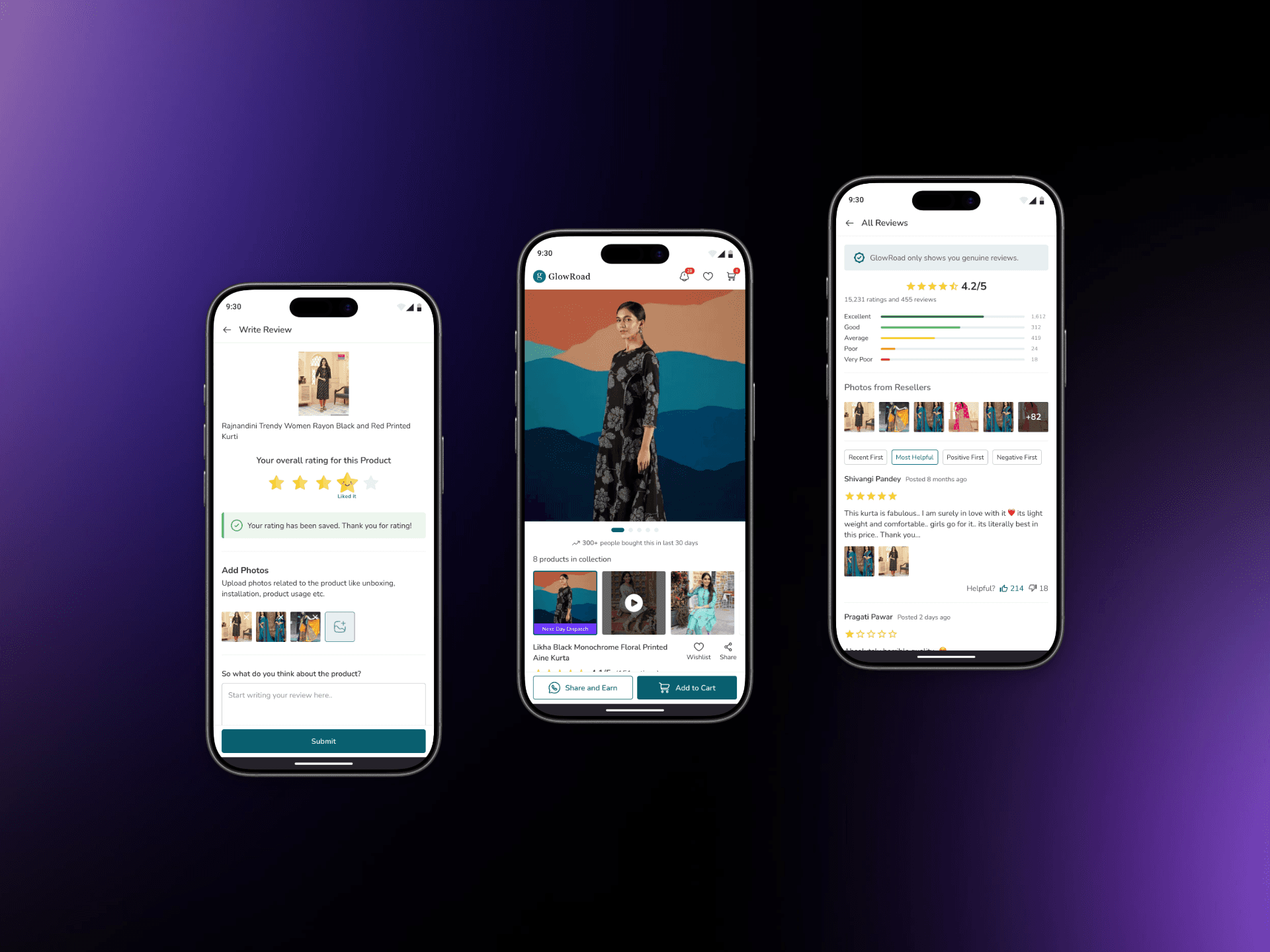
Due to NDA and confidentiality constraints, detailed product screenshots and internal artifacts cannot be shared. The case study focuses on process, system thinking, and outcomes rather than visual UI.
Happy to walk through visuals, real examples, and deeper details during interviews or live discussions.
Amazon - GlowRoad
e-Commerce
Lead UX Designer
Dec 2023 - Feb 2024
Overview
The core objective of this initiative was to revamp the product detail page of GlowRoad, tailoring it to the unique preferences and behaviors of the resellers. By addressing the existing usability shortcomings and fostering an intuitive, trustworthy, and relevant user experience, we aimed to elevate user engagement, restore confidence in purchase decisions, and bolster overall app performance.
Problem Statement
The product detail page of GlowRoad presented significant usability obstacles, leading to user frustration and a potential loss of sales opportunities. Users struggled with comprehending essential product information, navigating through intricate details, and gauging the credibility of the product and seller. The app lacked an optimal user experience, hindering users' ability to make confident and informed purchase decisions. As a result, user satisfaction levels were compromised, leading to decreased conversion rates.
SWOT Analysis
💪 Strengths
Strong social commerce powered by WhatsApp sharing
Large, active reseller base with high reach potential
Wide product catalog across key everyday categories
Built-in incentive model that motivates sharing
⚠️ Weaknesses
PDP lacks clarity for confident decision-making
Ambiguous sharing actions create user errors
Weak trust signals (UGC, reviews, ratings)
Missing critical information like exact delivery dates
🚀 Opportunities
Improve reseller confidence through clarity & transparency
Use UGC and social proof to increase conversion
Optimize PDP as a selling tool, not just a browsing page
Enable cross-selling and upselling via related products
⚡ Threats
Competing platforms with clearer PDP experiences
Loss of reseller trust due to incorrect sharing or delivery issues
Drop in repeat buyers if credibility is impacted
High dependence on resellers’ personal reputation
User Persona

Rahul Verma
Age: 29
Location: Tier 2 city, India
Occupation: Part-time reseller
Gender: Male
🎯 Goals
Share products quickly without confusion
Look credible and informed in front of buyers
Avoid delivery-related complaints
Increase repeat customers
🧠 Motivations
Extra monthly income
Social credibility within his network
Low-effort selling that fits into his workday
Tools that help him answer buyer questions
😖 Pain Points
Confusing sharing actions (product vs collection)
No clear delivery date to commit to buyers
Lack of real-user reviews or photos
Hard to recommend add-ons or alternatives
Buyers asking questions he can’t answer
🧑💻 Behaviors
Shares products primarily via WhatsApp
Skims product pages quickly
Prioritizes delivery speed and ratings
Avoids products with unclear information
Uses buyer questions as a signal of trust
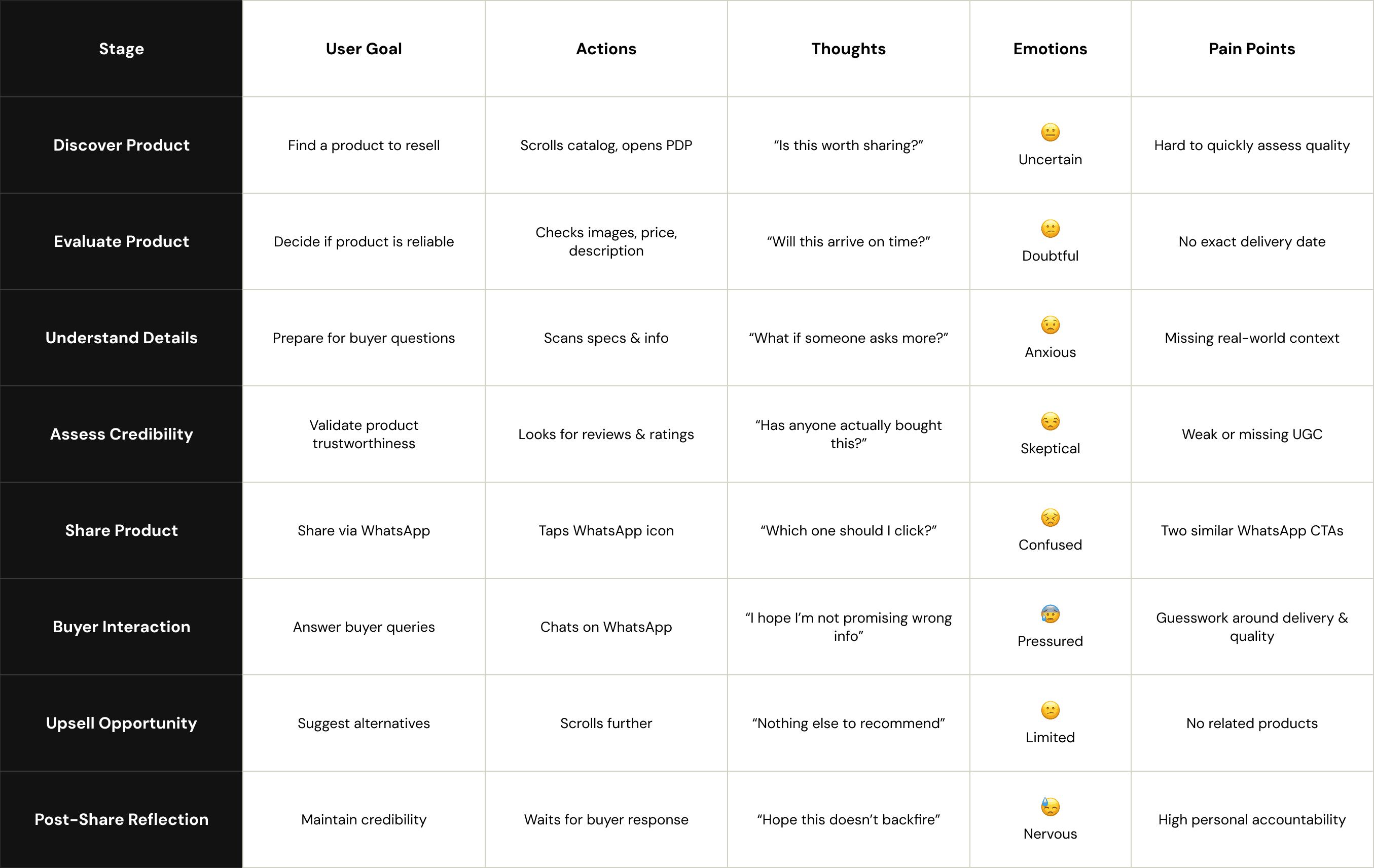
User Journey Mapping
Key UX Interventions
1️⃣ Ambiguous WhatsApp Sharing → One Clear Decision Point
Problem:
Two identical WhatsApp icons triggered different actions, confusing users.
Design Move:
Merged both actions into one primary CTA
Introduced a bottom sheet asking users what they want to share: Product only or Entire collection
Why it worked:
✔ Removed guesswork
✔ Made sharing deliberate
✔ Reduced accidental actions
2️⃣ Vague Delivery Info → Exact Delivery Date
Problem:
Users couldn’t confidently answer “When will this arrive?”
Design Move:
Introduced pin-code–based delivery date
Displayed exact delivery window inline on PDP
Why it worked:
✔ Sets expectations
✔ Improves purchase confidence
✔ Reduces support queries
3️⃣ Low Trust → Strong UGC & Social Proof
Problem:
Minimal user-generated content reduced credibility.
Design Move:
⭐ Ratings & reviews directly on PDP
📸 User photos & videos❓
❓ Q&A section for real-world doubts
Why it worked:
✔ Builds trust
✔ Reduces uncertainty
✔ Encourages peer-to-peer reassurance
4️⃣ Hidden Feedback → Ratings on PDP
Problem:
Ratings were only accessible via “My Orders.”
Design Move:
Enabled rating & review directly from PDP
Reduced steps required to leave feedback
Why it worked:
✔ Higher review participation
✔ Fresher, more relevant feedback
✔ Better decision data for buyers
5️⃣ Dead Ends → Related & Paired Products
Problem:
No next step after viewing a product.
Design Move:
'Pair with These Products' section
'Similar Products' section
Why it worked:
✔ Increased discovery
✔ Cross-sell & upsell opportunities
✔ Higher engagement per session
Impact and Takeaways
Building an enterprise design system taught me valuable lessons about organizational change, technical leadership, and sustainable design practices.
UX Impact (Qualitative)
Reduced confusion during sharing
Faster decision-making on PDP
Stronger trust signals for first-time buyers
Clearer product storytelling for resellers
Key Takeaways
Clarity beats abundance
Trust is built through visibility, not claims
Sharing flows must respect user intent
PDPs are decision engines—not just product displays
Due to NDA and confidentiality constraints, detailed product screenshots and internal artifacts cannot be shared. The case study focuses on process, system thinking, and outcomes rather than visual UI.
Happy to walk through visuals, real examples, and deeper details during interviews or live discussions.